What a 6-Hour Sound Ceremony Actually Looks Like
I
If you've been to a sound bath at a studio in the city, you have a reference point. It's a useful one. But it's like comparing a 5K to an ultramarathon. The mechanics are related. The experience is not.
A 45-minute sound bath is designed for relaxation. You lie down. Singing bowls play. You feel calmer when it's over. That's valuable, and it's real. But it's a fraction of what a sound ceremony can do when it's given the time, the instruments, the facilitation, and the container to go deeper.
At our retreats, the Saturday evening ceremony runs roughly six hours. It is the centerpiece of the weekend — the experience everything else is built around. Here's what that actually looks like from the inside.
The space is built before you enter it.
The facilitation team spends hours preparing the room. This isn't about aesthetics — although the space is intentional and beautiful. It's about energy. The placement of instruments, the lighting, the temperature, the airflow. Every element is considered. By the time you walk in, the room is already holding something.
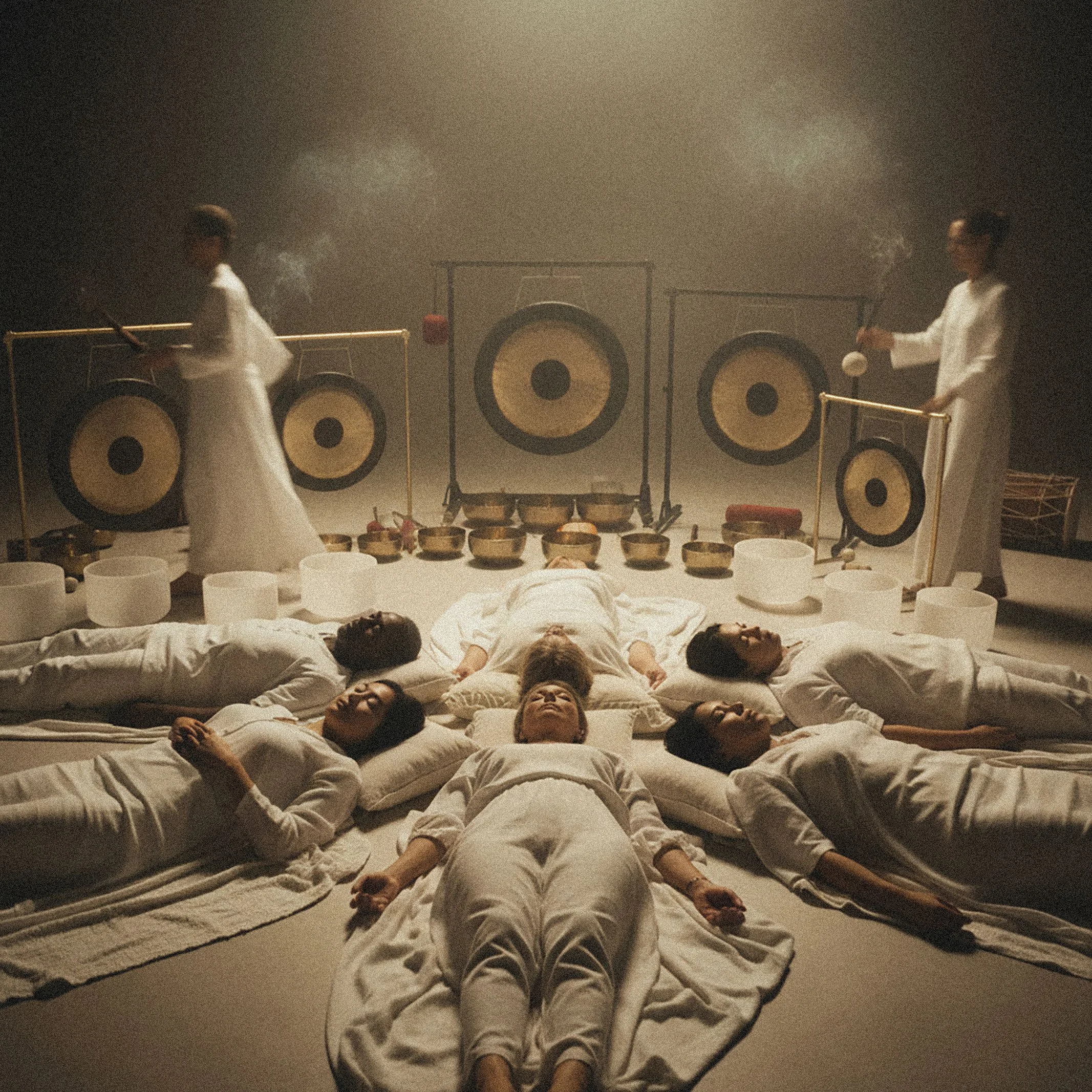
You'll see more instruments than you've likely encountered in one place. Over the course of the evening, the facilitators work with 20 to 30 different instruments — Tibetan singing bowls, crystal bowls, gongs, frame drums, ocean drums, rattles, chimes, tuning forks, shruti boxes, didgeridoo, handpan, tongue drums, rain sticks, and others that don't have names you'd recognize. Each one carries a different frequency, a different texture, a different invitation to the body.
This isn't a playlist. It's a live, responsive, evolving soundscape created by multiple facilitators working in concert — reading the room, reading each other, adjusting in real time.
It begins slowly.
You lie down. Blankets, pillows, eye mask — whatever helps you settle. The opening is gentle. Soft tones. Space between sounds. The purpose of the first phase is arrival — helping your nervous system transition from the day into a state where deeper work becomes possible.
This is where breathwork enters. The facilitators guide you through breathing patterns that amplify what the sound is already doing. The breath opens the body. The sound moves through what the breath has opened. They work together in a way that neither does alone.
You may also be guided into vocalization — toning, humming, or using your own voice as an instrument. This can feel vulnerable at first. You're in a room with eleven other people, and you're being asked to make sound. But something shifts when a group vocalizes together. The vibration isn't just external anymore. It's coming from inside your own chest, your own throat. The boundary between the sound and the person hearing it dissolves.
The middle hours are where the ceremony deepens.
This is the part that doesn't exist in a 45-minute session. Around the second or third hour, something happens that's difficult to describe but unmistakable when you're in it. The thinking mind quiets — not because you've forced it, but because the sound has given it something else to do. The body takes over.
This is where emotional material surfaces. Grief. Joy. Anger. Tenderness. Things you didn't know you were carrying. Things you knew about but hadn't been able to reach. The sound doesn't create these feelings — it creates the conditions for them to move. And in a six-hour container, they have room to move fully. There's no rushing. No clock. No need to wrap it up and get back to your evening.
During this phase, hands-on bodywork may be integrated. Rex — trained at Esalen and Kripalu in massage, Ayurveda, Zero Balancing, and multiple healing modalities — moves through the room offering targeted physical support. A hand on the shoulder. Pressure along the spine. Work on the feet, the hands, the neck. This isn't scheduled or mandatory. It's responsive. If your body is holding tension that the sound alone isn't reaching, the bodywork meets it directly.
The combination — sound entering the body from the outside, breath moving through it from within, skilled hands working on the physical tension — creates something that none of these modalities achieves independently. It's not additive. It's multiplicative.
Four facilitators hold the space the entire time.
This is worth emphasizing. You are not alone in this experience. Four facilitators — each with a different skillset, each with decades of practice — are in the room for every minute of the ceremony. They're not performing. They're holding. Reading. Adjusting. Supporting.
One facilitator might be playing a gong sequence while another is guiding breathwork. A third might be offering bodywork while a fourth is tending to someone who needs quiet attention. The team communicates without words — through eye contact, movement, and the shared intuition that comes from working together across many retreats.
This is why the screening process exists. This is why groups are capped at twelve. The level of attention each person receives in this ceremony is only possible because the ratio is intentional.
The final phase is integration, not conclusion.
A ceremony this deep doesn't end with an abrupt stop. The final hour is a gradual return. The sounds soften. The tempo slows. The facilitators guide you back into your body, into the room, into awareness of the group around you.
There's usually silence. Real silence — the kind that twelve people create together after sharing something they can't fully articulate. It's one of the most powerful parts of the entire weekend.
You won't be asked to talk about what happened. Not yet. Sunday's integration work is designed for that. Saturday night, you simply let it settle.
Why the length matters.
A 45-minute session is a taste. A six-hour ceremony is a journey. The depth of what can surface, process, and release in an extended container is categorically different. The body needs time to trust the space. The nervous system needs time to let go of its defenses. The emotions that matter most — the ones that have been stored, managed, and avoided — don't show up in the first 20 minutes. They show up in hour three, hour four, when you've finally stopped trying to control the experience and let the experience have you.
That's not something you can shortcut. And it's not something you should do without a team of experienced facilitators holding the space around you.
What people say.
The most common response we hear after the ceremony is some version of silence — followed, eventually, by: "I've never experienced anything like that."
They're not being dramatic. They're being accurate.
The Saturday evening ceremony is the centerpiece of every Gift of Discomfort retreat. Our next retreat is June 12–14 in the Catskill Mountains. Apply here.